Esquant
A puzzle game in Unreal Engine: your first steps are recorded, then a clone replays them while you carry on.
- Year
- 2026
- Role
- All the C++ programming
- Team
- 2 people
- Technologies
- Unreal Engine, C++
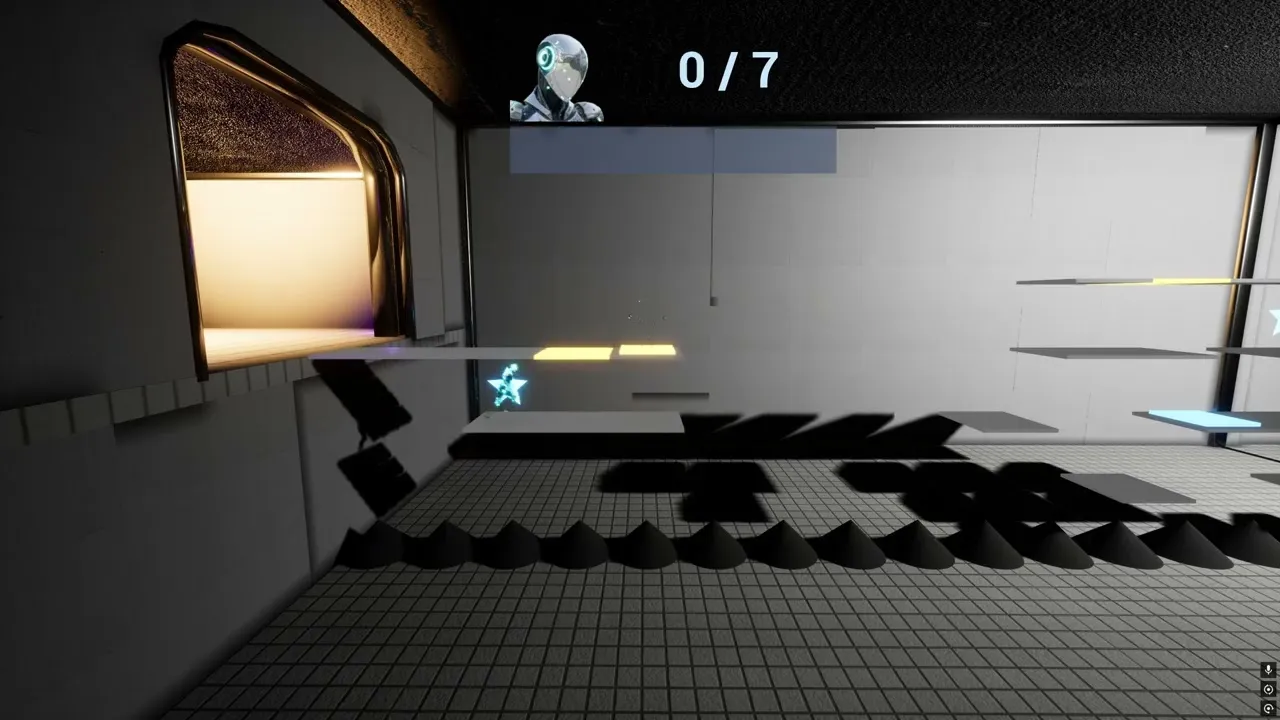
Esquant is a quantum-inspired puzzle game, built by two people with Unreal Engine between January and February 2026. I wrote all the C++ code; my teammate built the scenes and the Blueprints.
Retro-coherence
This is the core mechanic: the player shares the room with their own past.
- Their first actions are recorded, ten by default, a number that can be set room by room.
- A clone then appears on their starting cell and replays those actions, one for each step the player takes.
- The clone counts as a real occupant: it presses pressure plates, takes portals, and can remove a bridge from under the player’s feet.
- Standing on the same cell as the clone is fatal, and stays so once its actions run out.
Every puzzle therefore comes down to planning your first steps so that they pay off later.
The puzzle
- A side-view grid where you move cell by cell, with gravity computed on the grid.
- Ladders, bridges, spikes, pressure plates that fire once or while held, and twin portals that swap the player and the clone.
- One goal per room, the sanctuary, and an automatic restart on every death.
From 3D to the puzzle
You explore the world in third person. On entering a room, the game switches to the side view: a dedicated camera takes over with a blend, the controls change, and the puzzle only starts once the transition has finished. The reverse happens on the way out.
In the code
- Grid movement is a component shared by the player and the clone.
- Triggerable and interactive elements go through interfaces, so new ones can be added without touching the room manager.
- The code exposes events to Blueprints, so visual effects can plug in without changing the C++.